My Alignment Pyramid
Real-world outcomes feed back up. If my actions don't match my values, I adjust my systems and priorities.
Why · 1 of 4
Values
What matters for its own sake.
- Health
- Meaning
- Connection
- Kindness
- Experience
- Authenticity
- Honesty
- Trust
- Autonomy
- Beauty
- Action
- Courage
What · 3 of 4
Priorities
Where I focus my life.
Physical Healthsleep, diet, exercise5
- Train my body, train my mind
- 休息是為了走更長遠的路 Rest to go the longer journey ahead
- Enjoy nature and appreciate beauty.
- Don't accumulate a lot of unnecessary material items.
- Don't obsess over money.
Mental Healthknow, love, untether thyself8
- Don't be afraid to put myself first.
- Choose my battles, choose my sufferings.
- Be honest to myself, and represent myself honestly to others.
- Accept all emotions and understand where they come from.
- Don't worry about what other people think about me.
- Don't worry about things that are out of my control.
- Stay positive.
- Avoid unnecessary stress.
My Relationships and Their Wellbeing5
- Invest in long term, quality relationships.
- Be curious not judgmental
- Be playful and kind, I’m playing Grand Theft Life
- Don’t half ass things you commit to
- Nothing happened in the past, everything happened in the now. Make the NOW the primary focus of your life.
Life’s Purposesolve real problems with people I love9
Flow and antifragility
- Do things that add to my long term goals.
- Admit when I don't know something.
- Ask myself what my future self will wish I did now.
- Don't half-ass life.
- Hard work is critical to success.
- Never stop learning.
- Be willing to learn anything from anyone I come across.
- Aim for growth over comfort.
- Take responsibility for myself.
Making Others’ Lives Bettercreate for good4
- make smth people want, smth society needs
- Be a channel for good things to happen in the universe.
- Be a net positive to society.
- Life is precious.
Do · 4 of 4
Systems
Repeatable systems that turn priorities into daily action.
- Habits
- Routines
- Environmental triggers
- VAST goals
Principles & Mental Models
Life is HEALTH, LOVE, MISSION — in that order.
Inner life
Happiness & meaning
3 goals in wellbeing: purpose, relationships, routines (sleep, eat, exercise, no drinking/smoking)
Eudaimonia: happiness is something you do, not something you feel. Live fully by using your best abilities; joy is the byproduct. No achievement is ever "enough" on its own (Aristotle, Aquinas). Eudaimonia & Aquinas: happiness is something you do
Wellbeing = mental wellbeing * physical wellbeing * meaning (ikigai)
Wellbeing = enjoyment + satisfaction + meaning (ikigai)
- Physical wellbeing = exercise * sleep * food
- Mental wellbeing = relationship with self * relationship with others
- Relationship with self = equanimity + savoring + expressing & reflecting
- Relationship with others = (chemistry + compatibility) * communication * action
- Chemistry = Physical, material, intellectual attraction.
- Compatibility: Emotional, spiritual compatibility.
- Meaning comes from 1. Creating great work 2. Experiencing something or smtn 3. Attitude towards suffering
- Great work = self mastery * group mastery
- ∑₀→t (work hard + work smart) × direction = achieving goals
- Nietzsche’s words, “He who has a why to live for can bear with almost any how,”
Things that actually make us happy/how to be happier:
- rethink what "awesome stuff" is
- invest in experiences over things
- thwart your hedonic adaptation
- savor enjoyable moments; take a second to really be there and enjoy it
- use negative visualization ("what if I didn't have this awesome thing?")
- think as if today was your last day to increase gratitude (esp. in terms of jobs)
- practice gratitude daily
- reset your reference points (i.e., what are you comparing your life/stuff to?)
- interrupt consumption (take a break from a good movie or fun thing; it will make you appreciate coming back to it more - commercial breaks actually increase enjoyment of shows)
Things that actually make us happy- signature strengths in a job > money
- "flow" in a job > money
growth mindset> fixed mindset (Mindset — carol dweck)- Focus on learning not looking good
- Hard work leads to improvement
- Learn from mistakes, face challenges
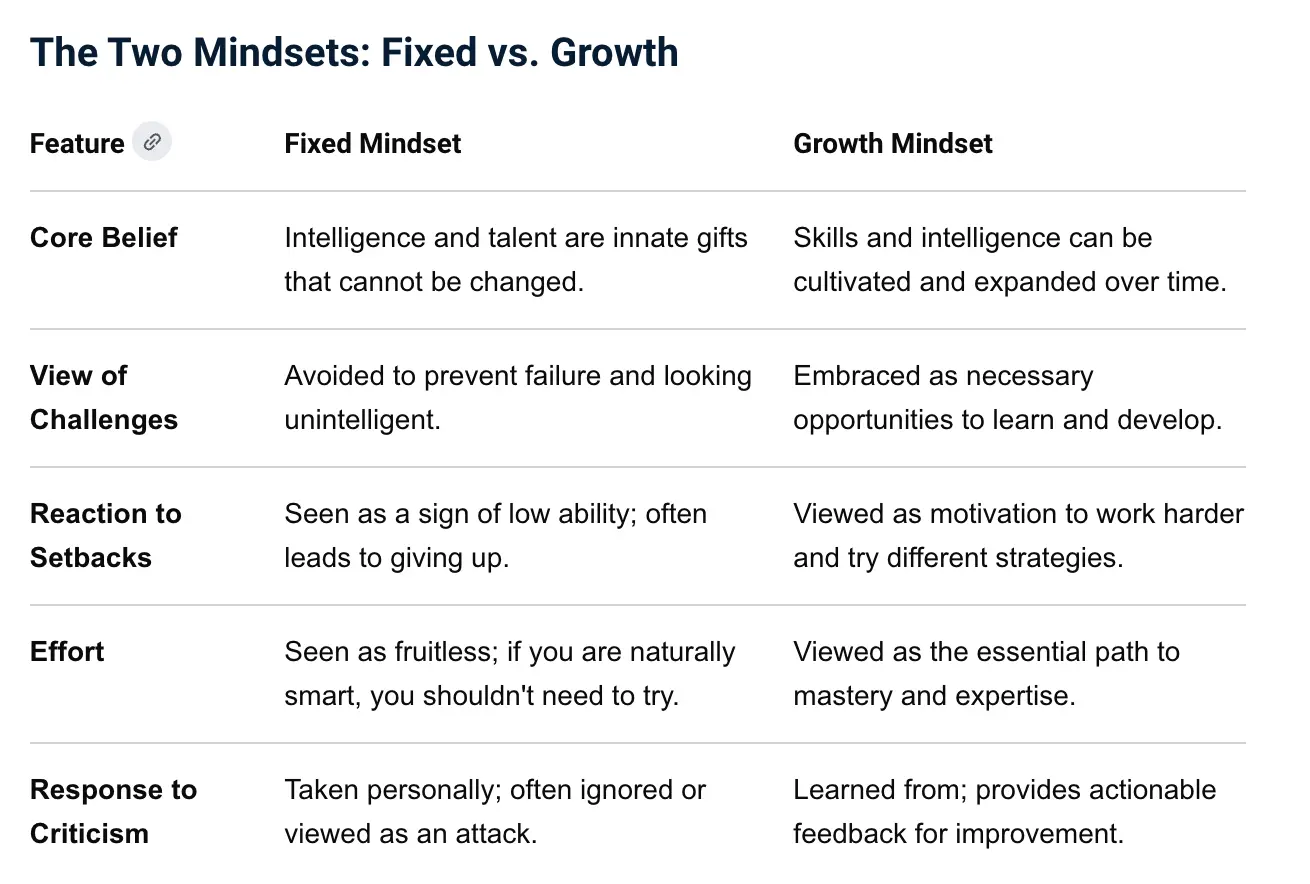
The Two Mindsets: Fixed vs. Growth
- The Power of "Not Yet": Rather than viewing a failure as a dead end, individuals with a growth mindset understand they just haven't mastered it yet.
- Resilience: People who prioritize learning over looking smart demonstrate profound resilience in the face of obstacles. [1, 2, 3]
- Cultivating a Growth MindsetYou can actively develop a growth mindset by changing how you speak to yourself and others.
- Praise Effort, Not Talent: When praising children or yourself, focus on the process (hard work, strategy, perseverance) rather than inherent traits (e.g., being "smart"). [1, 2]
- Embrace Mistakes: Treat errors as vital pieces of data that show you where to improve, rather than proof of inadequacy. [1, 2]
- Change Your Inner Voice: Notice when your "fixed mindset" voice pipes up—usually when you feel challenged or jealous of others—and consciously reframe the thought into a growth-oriented one. [1]
- practicing kindness
social connection(even when you think it will not make you happy!!!)time affluence> money (value your [free] time more than money)- mindfulness via meditation
- exercise
- good sleep
- implementation
- use situational support (e.g., putting candy in a drawer instead of on your desk will make you less likely to eat it; set yourself up for success)
- set specific goals
- practice goal implementation intentions (i.e. If it is this time in this place, I will do this behavior)
- Practice WOOP - Wish, Outcome, Obstacle, Plan
The answer to the meaning of life.
Frankl approvingly quotes the words of Nietzsche: “He who has a Why to live for can bear almost any How.”
According to logotherapy, we can discover this meaning in life in three different ways: (1) by creating a work or doing a deed; (2) by experiencing something or encountering someone; and (3) by the attitude we take toward unavoidable suffering.
The second way of finding a meaning in life is by experiencing something—such as goodness, truth and beauty—by experiencing nature and culture or, last but not least, by experiencing another human being in his very uniqueness—by loving him.
Is Because. There is no singular answer, any answer leads u to the Agrippas trilemma, where u keep asking why (infinite regress), or circular reasoning or an axiom like god or big bang or simulation, there all the same thing. The beauty of life is that you create your own meaning. If there was a single answer then we’d be trapped chasing it. Instead do whatever you want. You’re both a unique being, and infinitely connected to the universe a human on earth, in solar system, made by star dust. You have to create the entire universe to describe u. You’re connected to everything it’s inseparable. So the answer to do I matter? Is i am nothing and i am everything. The answer to all great questions are paradoxes.
The macronutrients in True happiness is enjoyment, satisfaction (working hard to get smtn), meaning (ikigai). enjoyment, acceptance, enthusiasm (a new earth)
what are u passionate about:
- deep enjoyment: living in the present, engaging my 5 senses, movies, books, art pieces, doing what you want to see yourself doing.
- deep creation: flow state generative hobbies
Enjoyment is about what do u do for leisure, how do u feel after? is there people or memory involved? doing what you want to see yourself doing. animal instincts vs moral aspiration. Happiness has unhappiness in it
- deepen relationships on purpose,
- learning something you don’t need to learn,
- developing urself metaphysically: philosophically, spiritually (seek transcendence)
Aim for a life of maximizing aggregate joy, peace, content, meaning and that of others
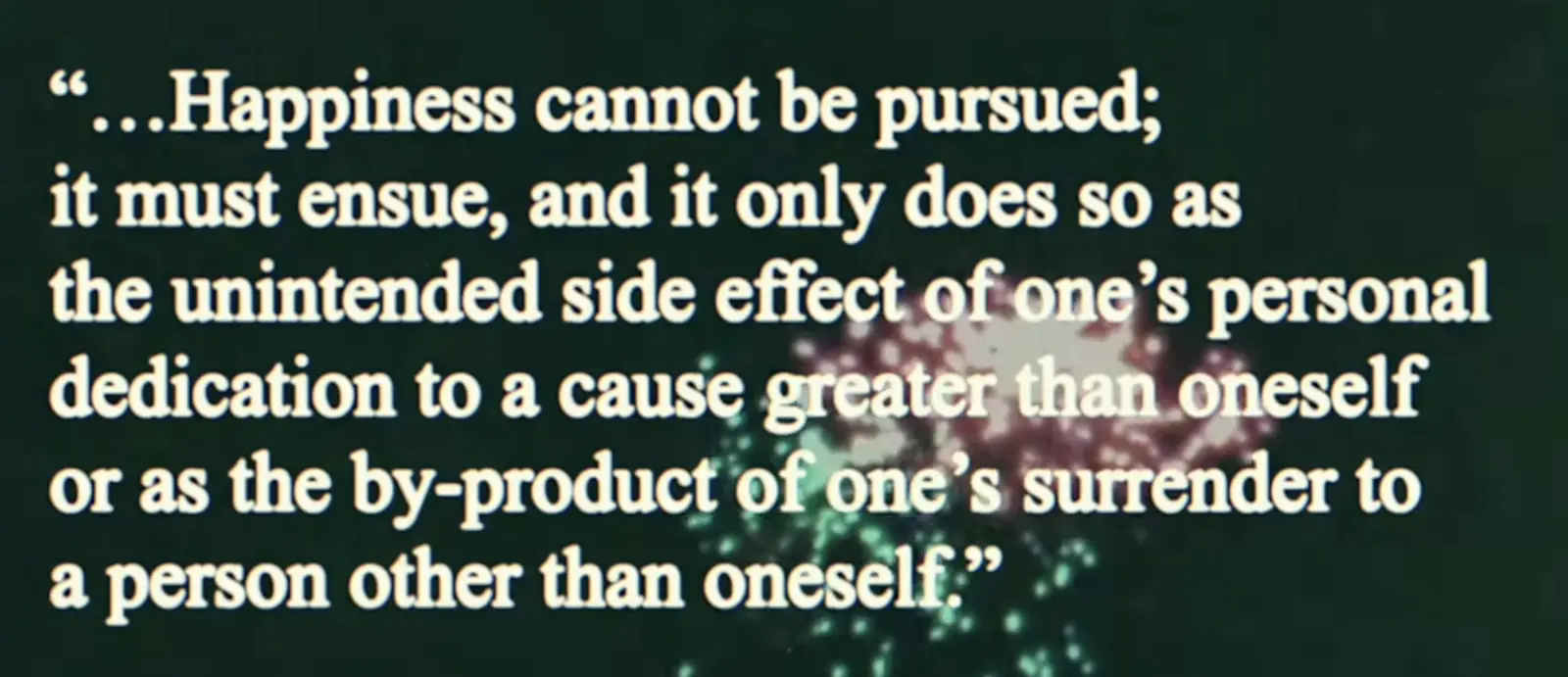
- happiness cannot be pursued; it must ensue. One must have a reason to “be happy.” Once the reason is found, however, one becomes happy automatically. As we see, a human being is not one in pursuit of happiness but rather in search of a reason to become happy, last but not least, through actualizing the potential meaning inherent and dormant in a given situation.
- The desire for more positive experience is itself a negative experience. And, paradoxically, the acceptance of one’s negative experience is itself a positive experience.
- Problems are a constant in life. When you solve your health problem by buying a gym membership, you create new problems, like having to get up early to get to the gym on time, sweating like a meth-head for thirty minutes on an elliptical, and then getting showered and changed for work so you don’t stink up the whole office. When you solve your problem of not spending enough time with your partner by designating Wednesday night “date night,” you generate new problems, such as figuring out what to do every Wednesday that you both won’t hate, making sure you have enough money for nice dinners, rediscovering the chemistry and spark you two feel you’ve lost, and unraveling the logistics of fucking in a small bathtub filled with too many bubbles.
Problems never stop; they merely get exchanged and/or upgraded.
Happiness comes from solving problems. The keyword here is “solving.” If you’re avoiding your problems or feel like you don’t have any problems, then you’re going to make yourself miserable. If you feel like you have problems that you can’t solve, you will likewise make yourself miserable. The secret sauce is in the solving of the problems, not in not having problems in the first place.
To be happy we need something to solve.Happiness is therefore a form of action; it’s an activity, not something that is passively bestowed upon you, not something that you magically discover in a top-ten article on the Huffington Post or from any specific guru or teacher. It doesn’t magically appear when you finally make enough money to add on that extra room to the house. You don’t find it waiting for you in a place, an idea, a job—or even a book, for that matter.
Happiness is a constant work-in-progress, because solving problems is a constant work-in-progress—the solutions to today’s problems will lay the foundation for tomorrow’s problems, and so on. True happiness occurs only when you find the problems you enjoy having and enjoy solving. - joy comes from compassion towards yourself and others.
- True long term happiness is an effect of good relationships, flow state, meditation, good physical health → less active dmn, less self, less ego, less thinking abt the past, less rumination, more present. If u chase happiness directly, u might be chasing pleasure instead or spend too much thinking about what is missing. Expectation is a contract u make with yourself to not be content until u meet that expectation.
- happiness cannot be pursued, it must ensue. those who place experienced greater unhappiness than those who placed little importance on achieving it. Another study found that merely thinking about being happy during a joyful moment made people feel less happy. It's as if monitoring
- Treat your current activity like a dance. In dancing, the goal is not to reach a specific spot on the floor; the goal is to dance right now.
- “sadness is the price we pay for love, the only way to not feel pain is to never feel love. There is a type of love that is only experienced through sadness, there is a type of joy that is only experienced through grief. When we show compassion, empathy, that’s the most beautiful form of love there is.”
Presence & inner peace
Stop thinking to find out what life is about, to come into immediate contact to the unspeakable world
- be less impress and more involved
- As Eckhart says in A New Earth, "
There are three words that convey the secret of the art of living, the secret of all success and happiness: One With Life. Being one with life is being one with Now. You then realize that you don't live your life, but life lives you. Life is the dancer, and you are the dance."You are not a noun moving through life. You are a verb being life. Being present: But you know, if you talk all the time, you will never hear what anybody else has to say, and therefore, all you’ll have to talk about is your own conversation. The same is true for people who think all the time. That means, when I use the word ‘think,’ talking to yourself, subvocal conversation, the constant chit-chat of symbols and images and talk and words inside your skull. Now, if you do that all the time, you’ll find that you’ve nothing to think about except thinking, and just as you have to stop talking to hear what I have to say, you have to stop thinking to find out what life is about. And the moment you stop thinking, you come into immediate contact with what Korzybski called, so delightfully, ‘the unspeakable world,- The most ordinary sights and sounds and smells, the texture of shadows on the floor in front of you. All these things, without being named, and saying ‘that’s a shadow, that’s red, that’s brown, that’s somebody’s foot.’ When you don’t name things anymore, you start seeing them. Because say when a person says ‘I see a leaf,’ immediately, one thinks of a spearhead-shaped thing outlined in black and filled in with flat green. No leaf looks like that. No leaves — leaves are not green. That’s why Lao-Tzu said ‘
the five colors make a man blind, the five tones make a man deaf,’ because if you can only see five colors, you’re blind, and if you can only hear five tones in music, you’re deaf. You see, if you force sound into five tones, you force color into five colors, you’re blind and deaf. The world of color is infinite, as is the world of sound. And it is only by stopping fixing conceptions on the world of color and the world of sound that you really begin to hear it and see it. - I am not talking about the ordering of ordinary everyday life in a reasonable and methodical way as being school teacherish, and saying ‘if you were NICE people, that’s what you would do.’ For heaven’s sake, don’t be nice people. But the thing is, that unless you do have that basic framework of a certain kind of order, and a certain kind of discipline, the force of liberation will blow the world to pieces. It’s too strong a current for the wire
Be very very choosy of my sufferings. 99% of problems are created within our own mind. Rational person can find peace by cultivating indifference to things out of their control.
- fix ur life, ur family before stressing abt the world, news, modern media. Modern media takes the world’s mimetic viruses into ur head, in which most you have no control over, and most don’t affect you. take control of what you can control.
- Don’t stress abt things that are less than 100 bucks, flight fluctuations tho should always just book that day
Prayer is paying attention
Inner space: Take my time, in speaking, in changing, in finding my footing. All good things take time. People have patience 1~2 minutes before boredom comes.- Between stimulus and response there is a space. In that space is our power to choose our response.
Prayer may also come in the form of meditation, taking a walk to clear your mind, stargazing to feel the humility of awe, creating art, making love, writing, even laughter. All of these practices can be a form of prayer because they’re each a means of revival—of the heart, mind, and the human spirit.
Prayer is paying attention. In a world that constantly consumes our thoughts but distracts us from tending to our spirit, prayer gives our soul a chance to catch up with our pathologically busy minds, providing us with the contentment of self-awareness that gives us enough hope to admit that we actually do have the ability to live our life.
Think less of yourself. Flow is about being so fully focused on the task at hand that you forget your sense of self
- Time distortion, feels effortless, high creativity and performance, low self criticism
- reappraisal + hard work in things u can control; serenity and accepting every emotional state
- The ego, inner chatter saying “I’m this, this person wronged me, I deserved this, I got rejected from, this shouldn’t have happened, I need to get revenge on this, I need to fix that or change this …” is the source of most unhappiness or lack of peace; goal is to leave ur mind clearer after it.
- The less u think abt urself the more u think abt the universe as one. Take on problems bigger than urself, ur mission, family, humanity, the planet (of course don’t go too far)
- Make use of flow better in your free time! This is the so-called deep rest that you pair w deep work. The more often people report reading books, the more flow experiences they claim to have
- meditation journaling working out exec coaching/therapy as needed boundaries around work + life prioritizing family + relationships + friendships (outside work) prioritizing sleep
- Movies, salsa, art as well!
- Choose activities that are active rather than passive. Reading books vs watching tv. Do sports and other generative hobbies. Engage in social interactions, esp those requiring concentration, say deep convos.
desire without attachment:
Attachment is not “having goals.” Attachment is “my peace depends on this goal.”
Healthy desire is:
- clear preference
- directed energy
- enthusiasm for a possibility
- willingness to act for it
And at the same time:
- acceptance that reality might say “no”
- flexibility to update when conditions change
- self respect whether it works or not
- have low expectations - charlie munger
Don’t get mad at things that are out of my control, believe in dots connecting in the future
- my hourly wage in future is 1000+, now it’s 400.
- Under 200 dollars increase
- < 30m increased waste of time → it could’ve been a lot worse
Relationship with yourself
Don’t half ass it, life, relationships, the present. ownership mentality. — Matthew McConaughey 知道到做到是世界上最長遠的路
to be a missionary and a philosophy warrior
Somewhere between the janitor and the CEO, reasons stop mattering. Own outcomes, not excuses. Extreme Ownership — Jocko Willink & Leif Babin
Steve Jobs’ janitor story for new VPs
Steve Jobs told employees a short story when they were promoted to vice president at Apple. Jobs would tell the VP that if the garbage in his office was not being emptied, Jobs would naturally demand an explanation from the janitor. “Well, the lock on the door was changed,” the janitor could reasonably respond. “And I couldn’t get a key.” The janitor’s response is reasonable. It’s an understandable excuse. The janitor can’t do his job without a key. As a janitor, he’s allowed to have excuses. “When you’re the janitor, reasons matter,” Jobs told his newly-minted VPs. “Somewhere between the janitor and the CEO, reasons stop mattering.”
“In other words,” (Jobs continued,) “when the employee becomes a vice president, he or she must vacate all excuses for failure. A vice president is responsible for any mistakes that happen, and it doesn’t matter what you say.” — Steve Jobs
love my future self → u can be incredible in 20 years
- sleep is not the end of the day, it’s the beginning of tomorrow → set you up for tmr success
Live up to your own code. Do win-win games with yourself. Self esteem is the reputation you have of yourself. EARN UR SELF-RESPECT. But be aware of self loathing, balance w self belief
The only true intelligence is if you get what you want in your life. Getting what u want + wanting the right things. Earn self respect by finding your own traction. ask urselfIf someone filmed the last two hours, what would they conclude I want from my life?→ time is a proxy of priorities- To get what you want, you have to deserve what you want
- Balance self respect with self belief
“In fact this is just a sign. Belief doesn't just happen cause you hang something up on the wall. It comes from in here (heart) you know? Up here (brain) and down here (gut). Only problem is,
Only problem is we all got so much junk floating through us, a lot of times we end up getting in our own way. You know, crap like envy, or fear, shame. I don’t want to mess around with that shit anymore. You know what I mean. Do you?…
You know what I wanna mess around with? The belief that I matter… regardless of what I do or don’t achieve. Or the belief that we all deserve to be loved, whether we’ve been hurt or maybe we’ve hurt somebody else. Or what about the belief of hope? Yeah? That’s what I want to mess with.
Believing that things can get better. That I can get better. That we will get better.
Oh man. To believe in yourself. To believe in one another. Man, that’s fundamental to being alive. And look, if you can do that, if each of you can truly do that, can’t nobody rip that apart.” - Ted Lasso
- 人生要憨一點, think of ur life as a rainbow arcing the horizon of this world. Birth and death are the two end points, the journey is the reward. have a good sense of humor
- Build your
inner scorecard and your outer scorecardwill follow.To get what you want, deserve what you want.Immediacy doesn’t work, you have to put in the time.- to get something u never had, u gotta do something u never did
- Invert, invert, invert. avoid the standard ways of failing. the biggest traps in life, addiction, cigs, alcohol, extravagant living. Figure out where you don’t want to be and avoid it.
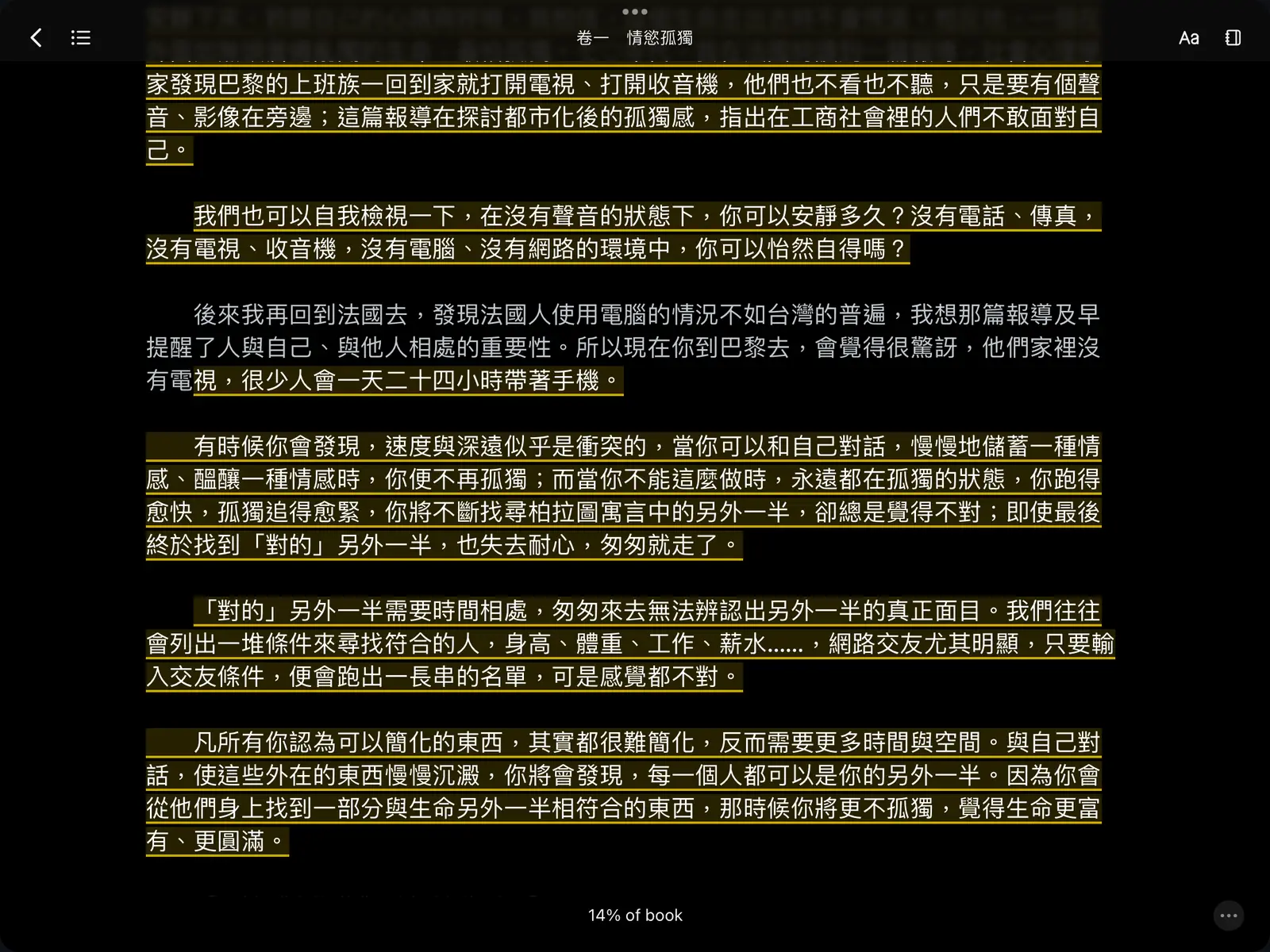
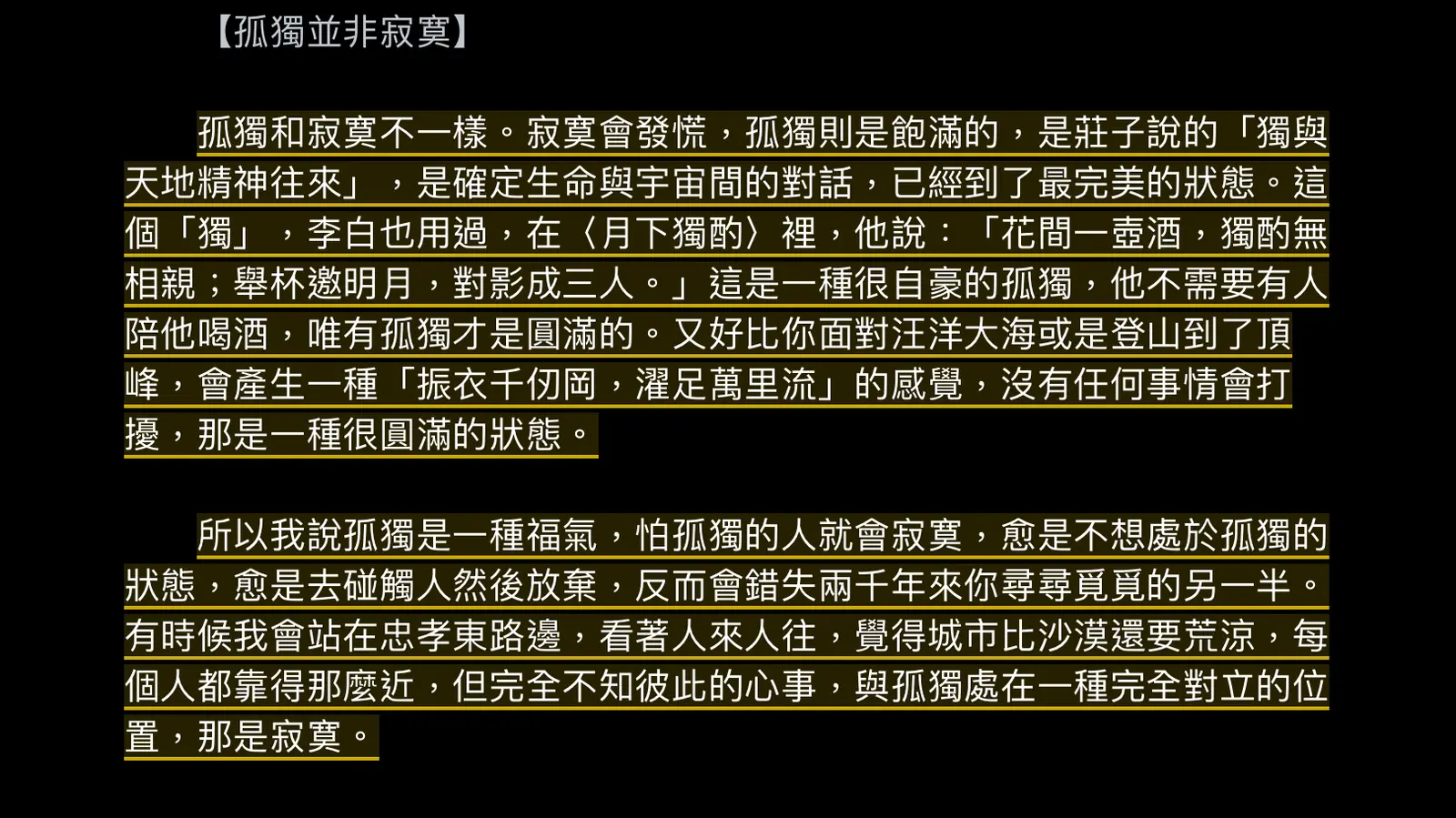
Train to cherish being alone: love yourself first to love others 孤獨會變得不好 是因為你害怕孤獨
To love others, you first have to love yourself. Enjoy your own company, trust your own abilities.
Self trust and confidence: Acceptance, Agency, Autonomy, Adaptability
- Acceptance: Embracing current realities, emotions, and your sense of self-worth ("Am I enough as I am?") without self-judgment. [1, 2, 3]
- Agency: Recognizing and believing in your personal capacity and power to influence outcomes and solve problems. [1, 2]
- Autonomy: Cultivating independent thinking and taking ownership to choose your response rather than reacting out of fear or control from the outside. [1, 2, 3]
- Adaptability: Developing emotional regulation and resilience to handle change, uncertainty, and setbacks without letting them dictate your next move
- Self correct to improve, be agnostic
- Two selves: thinking and analytical self vs feeling and sensing self; body intelligence
Mindset & resilience
Neuroplasticity -beliefs are thoughts you keep thinking again and again
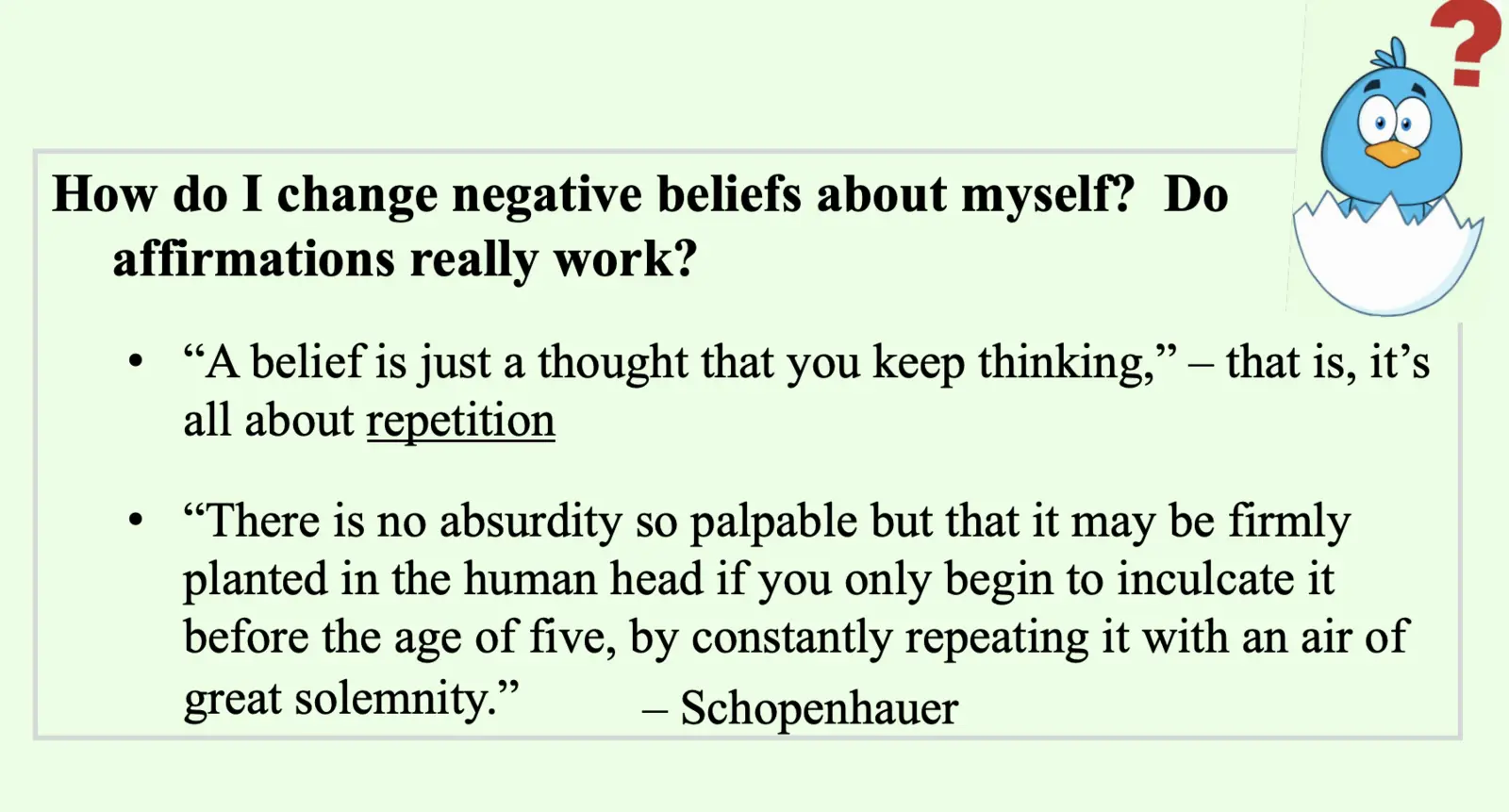
fake it till u make it. beliefs are just thoughts u repeat urself.
One of the best beliefs is: growth growth growth!
Nitin always says growth growth growth. Having a growth mindset means taking failures and challenges as something exciting and an opportunity to try again. Everything is a skill. Happiness. Work. Communication. Relationships.
Fall forward, antifragile
- maintain Antifragility,
SPIREmodel, valuing and chasing happiness is not the way to achieve happiness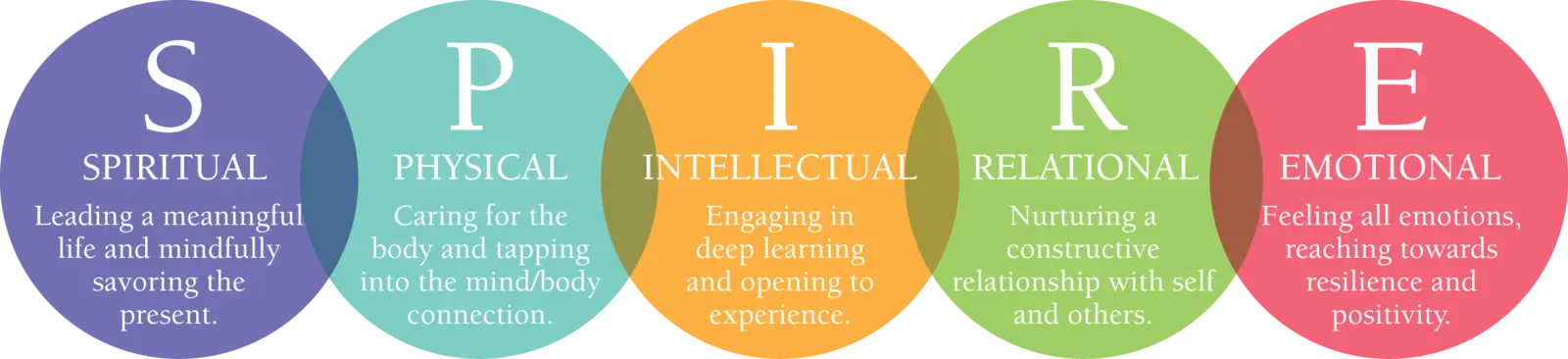
- Denzel Washington speech. Antifragile big think video
- There a dip that happens when forming a habit or a project, learning, 80/20 recognize it, embrace the suck, a pop quiz from the universe and anticipate it, practice it
Self talk creates reality.Law of attraction
- what you tell yourself influences how you feel and how you experience. Tell yourself you’re stressed abt this thing, u feel terrible. Tell yourself that’s not a big deal just relax, you then have a good time.
- the secret: Ask (be clear about what you want), Believe (trust that the universe will deliver), and Receive (feel the joy as if you already have it).
- When you really want something the whole universe conspires to help you achieve it
- Why, then, do some people find themselves feeling so empty? Frankl’s wisdom here is worth emphasizing: it is a question of the attitude one takes toward life’s challenges and opportunities, both large and small. A positive attitude enables a person to endure suffering and disappointment as well as enhance enjoyment and satisfaction. A negative attitude intensifies pain and deepens disappointments; it undermines and diminishes pleasure, happiness, and satisfaction; it may even lead to depression or physical illness.
pain and suffering → antifragile, fall forward
- kintsugi: repairing broken pottery with gold! celebrating an object's history and imperfections 翠玉白菜 (turn ur faults into something that makes u special)
- once u found the right business to plow into and it will compound in returns, it’s ok if u had 50 failed ventures or 50 failed job interviews, the number of failures doesnt matter, there’s no point in being a pessimist, you want to be an optimist. Be skeptical in the details, be optimistic in the big picture
- as long as I’ve learnt something from it, it’s a win. If i didn’t learn something it’s a loss.
- u are a lucky duck when you fall over because you experience weightlessness
Naive optimism, bright spot analysis
- Positive illusions → focus on the good and overlook the bad
Aways be connecting the dots. Trust in the things you can’t control when u did everything in ur control
- “You can’t connect the dots looking forward; you can only connect them looking backwards. So you have to trust that the dots will somehow connect in your future. You have to trust in something—your gut, destiny, life, karma, whatever. Believing that the dots will connect down the road will give you the confidence to follow your heart even when it leads you off the well worn path. This approach has never let me down, and it has made all the difference in my life.”
- Dropping out, scary at the time, but one of the best decisions I’ve ever made. Take interesting classes, following curiosity an intuition: calligraphy. Of course it was impossible to connect the dots looking forward, it’s very clear looking backwards ten years later.
- Getting fired was the best thing that happened to me.
Decisions & action
Thinking, perspectives & biases
How the mind learns and constructs a view of the world
- “Neurons that fire together wire together”: neurons responding to the same stimulus can connect to form neuronal ensembles. The more time I spend thinking about something, the more readily related thoughts may arise.
- Everyone has an incomplete view of the world, but we form a complete narrative to fill the gaps.
- Thinking Fast and Slow: the thing I’m thinking about can feel like the most important thing in my mind.
- Appealing fiction → confirmation bias.
- Negativity bias and novelty bias.
- Onion brain.
- Conservation of energy: changing reference levels can prompt action; change the environment.
Multiple perspectives and the halo effect
- Understand people in different dimensions, like seeing 太魯閣峽谷 from different perspectives; beware the halo effect and opinions of others.
- Counting’s 0th rule: if there is a bijection between A and B, their cardinalities are the same.
- Combinatorial proofs tell the same story from multiple points of view, using intuitive counting instead of tedious algebra.
Decision-making and biases
- Regret minimization framework.
- Peak-end rule: people tend to judge an experience by its peak and its end.
- Loss aversion: losing $20 can feel worse than gaining $20 feels good; consider how fear of missing an event affects a decision.
- 37% rule: when choosing sequentially under specific assumptions, observe the first 37% of options, then choose the next option better than all those observed. It is a heuristic, not a universal rule.
- 不要把自己的長處跟別人的短處比;and vice versa.
- Why
advice often sucks: take advice as data, not direction. They lack my full picture, default to their first idea, and take away my autonomy; their advice fits their life, not mine. Lay out my own thinking first, then ask “does this plan seem sound?” The Awkward Engineer’s Guide to Professional Networking — Nitin Julka - Invest deeply in the
2–3 peoplewho shape me most: prepare a real agenda before each meeting, listen hard, follow through. The Awkward Engineer’s Guide to Professional Networking — Nitin Julka
Motivation & procrastination
Action, motivation and procrastination
- The intention–action gap; penthouse vs. basement person.
- Five-second rule.
- Reasons for procrastination: a task is boring, hard, overwhelming, unstructured, lacking meaning, or lacking intrinsic rewards.
- Happiness is a by-product.
- Win even if you lose.
action precedes motivation next right thing, behavioral activation
- act first, do later. The bet is that action generates motivation rather than the other way around
- behavioral activation: we often think we have to feel better in order to do better, I need to feel better before I get out of bed. Whereas there’s a lot of evidence saying that when we step out of bed. When we force ourselves do first, the feedback that we get can actually be helpful.
Feel the fear, the anxiety, the loneliness but don’t let it define ur actions - what is the next best course of action, set aside practicality, fear, judgement, money. What’s the best thing to do, what is the best little step for that
- every motivational speech is susceptible to survivorship bias
- passion, success is a function of the value you bring to others, luck and timing (what’s possible now that wasn’t possible 10y ago & might get harder 10y from now
- dreams are a moving target. ask ppl how they’ve changed, personality, values… compared to when they were a student
i’ll tell u the result i u tell me the incentive. in action is having the subconscious goal of lpss aversion, being judged, safety, predictability
The first step to understanding the mind is to understand that all behavior is goal-oriented. It's teleological. You take a step forward because you want to reach a certain location. You scratch your nose because you want to make the itch go away.
Motivation = (Expectancy x Value) / (Impulsivity x Delay)
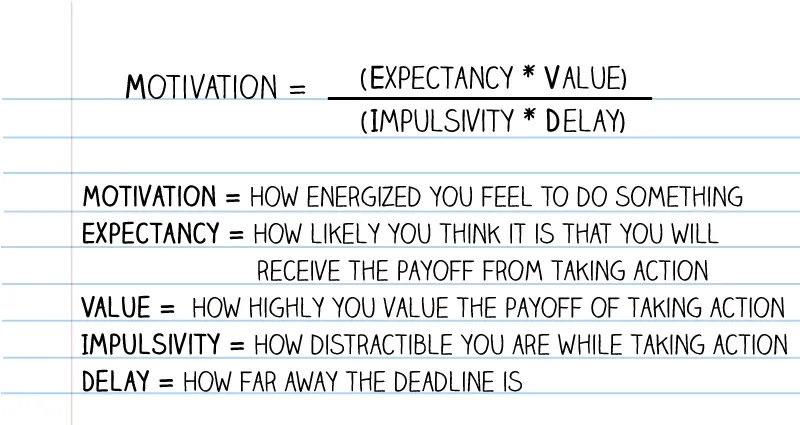
- Turn distraction into
traction: treat the urge as an internal trigger to notice and surf, not obey; timebox what I value, cut triggers that don't serve the plan, and pre-commit with effort, price and identity pacts for the in-the-moment choices willpower loses. Indistractable - Nir Eyal
Courage & discomfort
Courage, learning and growth
- Seek discomfort and embrace the unknown; take a leap of faith.
- Have the courage to become a novice again and again. Different battlefield, same principles.
- Crush cherished beliefs; do not calcify. Stay humble and practice unlearning.
- “Faced with the choice between changing one's mind and proving there is no need to do so, almost everyone gets busy on the proof.”
- “It isn't the learning that's so hard, it is the unlearning” — Charlie Munger.
- Read to stay curious about the world. Make friends with the eminent dead: learn from Iger, Durant, Brian Chesky, Disney, Munger, Tim Ferriss, Hugh, TED Talks, 張老師 and Gary Vee; also Tai Lopez and Newton.
- Experience and confidence: Oscar Wilde’s “experience is simply the name we give our mistakes.”
- Skiing and counterintuitive ideas: lean forwards to stop; Sorcerer’s Stone.
- The Secret, The Alchemist, believing, and people who are crazy enough.
- Let it go. Carpe diem.
Callous your mind, embrace the suck. seek discomfort to grow, pressure makes diamonds
Train your mind to push through discomfort! Anyone can do anything by training the mind to grow!
David goggins went from obese and 4th grade reading level to running 100miles without training, waking up 4am everyday training while doing a full time job and giving talks
Just as your hands build calluses from heavy physical labor, you must build mental toughness. You do this by deliberately exposing yourself to discomfort, adversity, and hard tasks instead of avoiding them
選難的那個做 Do the hard thing! delay gratification, only things u achieve after hard work over a long period of time will u feel lasting happiness (ur prefrontal cortex helps u do the hard thing). instant gratification like phones bring instant emptiness after
- You accept the challenge, not win or lose, that’s when you become a big man. Matthew mcconaughey
- Hear what is hard to hear.
40% rule — a Navy SEAL motivational heuristic, not a scientifically established measure of remaining capacity.
The idea is to question the feeling that you are completely exhausted; it is not a reason to ignore injury, illness, or physical limits.
While facing something really hard, draw mental strength from your cookie jar. All the hard things you’ve been through!
Tame your inner social survival mammoth. There’s almost always something extremely beautiful on the other side of fear.
- Embracing your fears is a muscle you have to keep training consistently day in and day out.
- channel ur inner mammoth: our fear also programs us to be terrified of all the wrong things. We’re more afraid of public speaking than texting on the highway, more afraid of approaching an attractive stranger in a bar than marrying the wrong person, more afraid of not being able to afford the same lifestyle as our friends than spending 50 years in a meaningless career—
all because embarrassment, rejection, and not fitting in really sucked for hunters and gatherers.Lose respect of your own fear. - You are playing Grand Theft Life: gta is a fake world where u can do things with no fear
- “Unlike GTA, in real life, the law is a thing and jail is a thing. But that’s about where the differences end. If someone gave you a perfect simulation of today’s world to play in and told you that it’s all fake with no actual consequences—with the only rules being that you can’t break the law or harm anyone, and you still have to make sure to support your and your family’s basic needs—what would you do? My guess is that most people would do all kinds of things they’d love to do in their real life but wouldn’t dare to try, and that by behaving that way, they’d end up quickly getting a life going in the simulation that’s both far more successful and much truer to themselves than the real life they’re currently living. Removing the fear and the concern with identity or the opinions of others would thrust the person into the not-actually-risky Chef Lab and have them bouncing around all the exhilarating places outside their comfort zone—and their lives would take off. That’s the life irrational fears block us from.”
Choices & regret
- stay upwind
Regret minimization.
Mistakes are those things that you did and wish you could do over again. regrets are most often things you didn’t do and wish you need.
- if it’s not a strong yes, it’s a no. In a lot of things, like dating, hiring… it’s like when u buy a shirt, if u hv a doubt it’s unlikely ur gonna wear it. don’t have doubts.
- Minimalism: have nothing in ur home that’s not beautiful nor useful
- Inverse! don’t do the things (or inactions) that make u fail: prevent failure
Health
Daily health foundations
- To be healthy is to exercise, sleep, eat well, build long-term relationships, and no smoking or drinking
Prevention & healthspan
Do anything to prevent sickness, ur health span is everything u have.
Brush and flosswithin 10m of eating anything sweet and sour!!!
- detect cancer early do mri cancer scans every 3 years
Relationships
Love, empathy & connection
Connection and perspective-taking
- SEX, LOVE, ATTACHMENT.
- 換位思考: consider another person’s perspective.
- 人情帳戶: the relationship account.
- Think of people as light wavelengths to reduce fear.
Love is simple w the right person: The Mark of True Love...
- they know how to and want to love us and we know and want to love them
- understand each person’s operating instructions
- instead of asking would i die for u ask would i live for u
The Thrill of being undressed by thought The Erotics of Intelligence
- There is nothing sexier than someone who listens, learns, and thinks deeply. Not because of credentials or qualifications, but because they care: about ideas, about others’ opinions, and about meaning.
- It’s the person who asks thoughtful questions and leaves space for nuance. It’s the person who sees learning as a collaboration, not a performance
- It's not about having gone to the right university or having read the right books; it’s about being emotionally literate, culturally curious, and intellectually generous.
- What is a mind if not a body draped in ideas, left just open enough to glimpse the heat underneath? The sexiest minds don’t give you everything. Instead, they want you to give all of yours. They make you reach for meaning, slip a shoulder back under the silk, and dare you to look closer.
“The dynamic that you build with someone — the shared norms, the in-jokes, the shared experiences — is so much more than the separate individuals who make up that relationship.” — Samantha Joel
Friendship & serendipity
- Knowing smn is not abt knowing facts but abt how they engage w the world
make other lives better. investing in relationships pay compound interests! the dividends are often unexpected but very valuable- Give like an
otherish giver: help generously and in focused chunks, but protect my own time, energy, and goals; selfless givers burn out, otherish givers last. 先顧好自己,才幫得久。 Give and Take - Adam Grant
Serendipity: You can’t plan: meeting people who will change your life.
people, people, people. i need to take my own advice, meeting others, chatting with others. serendipity really brings out the best in me always remember that. TEDx, genz, MUN friends, Felix, Janice, Zelin, Greg, SPIN event, linkedin event, improv, lunar accel, priscila, shivish... all these ppl doing cool things on their own!!
we are physically attracted to each other like literally! gravitationally
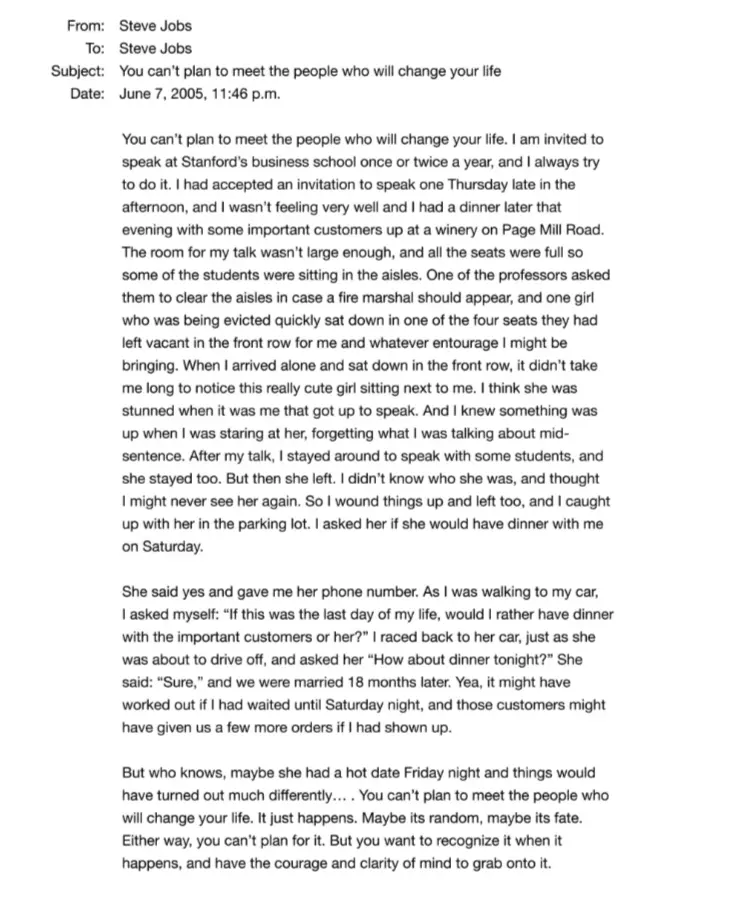
- Anyone is a hi away from being your friend. add a how are u doing… it’s a muscle u train for summer 2025
- Priorities should be reflected as a proxy in time spent and actions done, important ppl deserve chalantness
- Friendship closeness = proximity * quality * duration * frequency
- Confidence is like dancing without anyone watching
- Ppl talk abt what is interesting and what bothers them
- Nobel disease: don’t be the person who’s an expert about one area, but becomes arrogant in all areas.
Trust
It’s all about Trust: earn trust from others and trust for yourself. Trust is consistency over a long period of time. Trust only movement. Life happens at the level of events, not of words. Trust movement.– Alfred Adler
- Earn trust by every interaction, giving a positive experience: reliable, on time, humorous and lighthearted, compassionate and responds positively
- — see more in relationship section
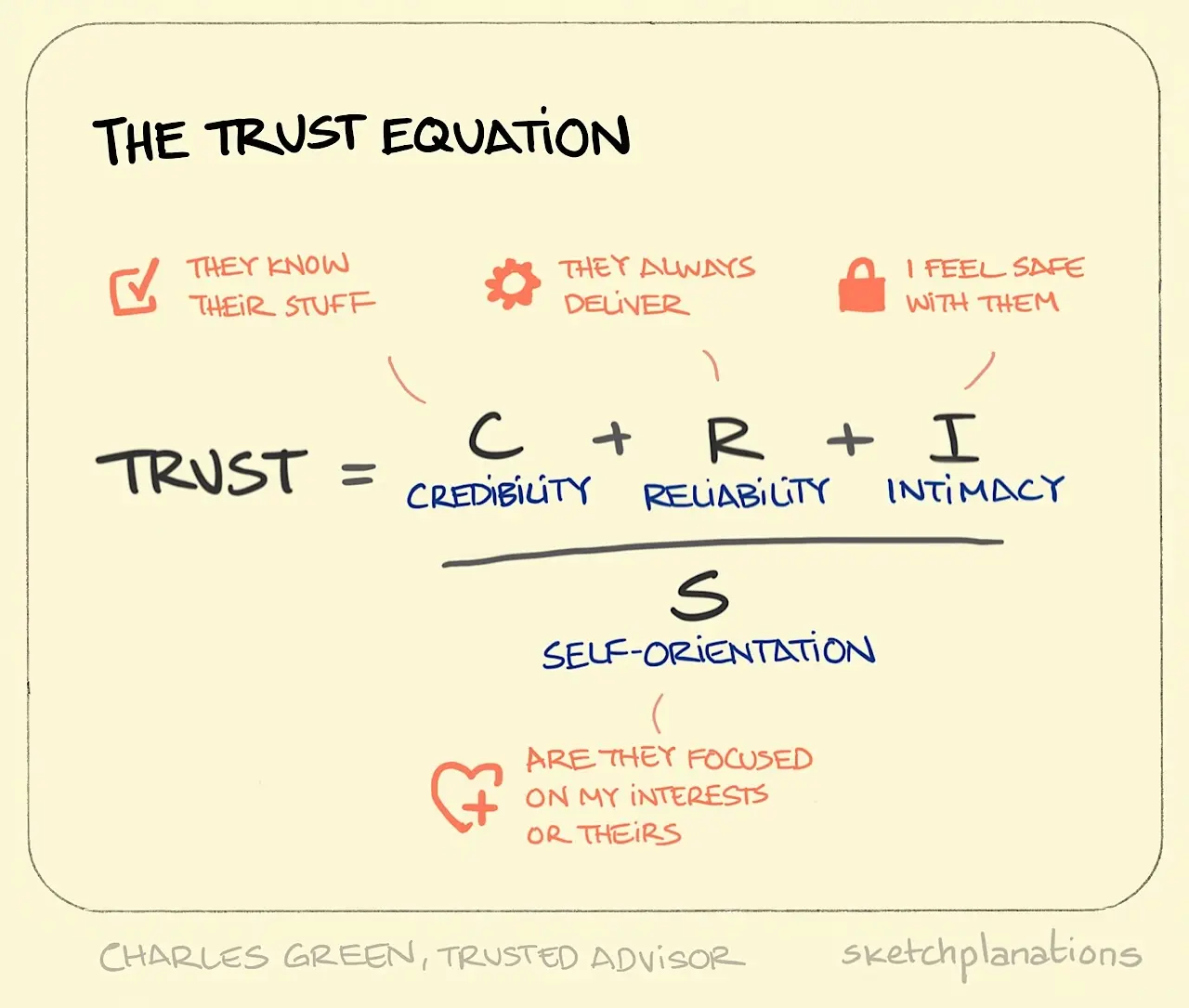
Trust equation = (Credibility + Reliability + Intimacy) / Self-Orientation
Meaningful work
Learning & creativity
Arm urself w specific knowledge, accountability, leverage
- Specific knowledge is hard to be taught in a class, but can be learned: innate characteristics, childhood/soft skills, brand new, on the job training → pattern matching, building judgement!
- If you can be trained in a class, u are replaceable. U do this by pursuing, double clicking on ur innate (22 and before) talents, genuine curiosity, and passion. Not going to school for whatever is the hottest job. Specific knowledge is at the edge of knowledge. 100% effort is important and compound interest. U find ur innate talents from observing.
- When specific knowledge is taught it is through apprenticeships. Does not scale, automate easily.
- Specific knowledge is both technical and creative.
- Freedom and responsibility → better work, owning equity, wanting to succeed more
- the ultimate foundations are math and logic → scientific method; separate truth from falsehood. Learn the foundations: algorithms, psychology, game theory, human behavior, microeconomics. Reading, writing, arithmetic, persuasion (communicating), programming (logic). Instead of “business case studies”.
Learn by doing. Do things that keep u up at night, you think abt when commuting, in the shower → ideas come subconsciously.
best way to learn something is to learn it, go through the pain of writing it, condensing it down to a simple truth, and sharing it to the world, and getting feedback.
be a chef. Leave your inner school“So if we want to think like a scientist more often in life, those are the three key objectives—to be humbler about what we know, more confident about what’s possible, and less afraid of things that don’t matter.”
- master first principles, instead of following recipes, master the essence of it and use it to your will. 張無忌 練武功 把招式都忘記才是真正的融會貫通
- Human hardware and software
- Know that u know nothing → reason up from first principles; know that everyone else also knows nothing → dogma is bs;
- Creativity and being a chef ultimately meaning connecting previous unrelated experiences and insights where others don’t see; this is how neurons work in both humans and CNNs
- Words are momentary, intent is momentous
服務窗口 vs 一張工作台: co-create throughout the process, not outsource everything to ai
工具讓我更容易碰到自己的想法,而不是要求我一開始就要把想法說得完美。
Preparation & consistent work
Balance my inputs and outputs
- Learn and grow by
output: product research+thinking, prep → 60% - Learn and grow by
input: reading, podcasting → 30% - Learn and grow by
sharing and connecting: medium, prof allies → 10%
The idea is that instead of having goals, I hope to build these principles in me!
Work, preparation and mastery
- Start early and allow a margin of error. I didn’t do that for 61A or Math 54; I’m on track to do it for 61B.
- Preparing is half the battle: the call with Frank about the future of wwtsa; preparing a plan, with kudos to Greg and Caillou.
- Hard work beats talent when talent fails to work hard; 10,000 hours. Sometimes you go through the storm to meet the rainbow.
- Courage doesn’t always roar: consistency matters. Sinek’s examples—brushing your teeth, acts of love, focusing on each possession and returning to training each season.
- Compound interest.
- Swiss knife.
- The Infinite Game, Start With Why, Essentialism.
- John T. Reed: identify the core principles of a field—often three to twelve—rather than trying to memorize every combination.
- Good work, consistently, over a long period of time.
- First, find the right thing (product market founder fit). Second, find the right people (the best people you can find, highest talent density). Third, work your hardest with long rest (like lion hunting, a marathon of sprints).
- When you have inspiration, act on it immediately.
Direction, leadership & environment
Leadership and finding direction
- Jun: the pull between talent and hard work; the marriage of what I’m good at, money, and passion or interest; novelty eventually wears off, whether in travel or other hedonic experiences.
- UGBA 10 leadership: creative tension between vision and reality; leadership types and MBTI; active listening using divergent and convergent thinking; the 3:1 positive ratio.
- Different Berkeleys: different communities and lives. My race is not everyone’s race — Joellene.
- Lead with
extreme ownership: no bad teams, only bad leaders. Explain the why, keep it simple, prioritize and execute, give intent and let others decide, be decisive under uncertainty. Discipline equals freedom. Extreme Ownership — Jocko Willink & Leif Babin - Be
demanding and caring: high standards + honest feedback + genuine care. Lead up, down and across; disagree in private, then commit fully. The Feiner Points of Leadership — Michael Feiner - Build the
keystone habit: keep the cue and reward, swap the routine; pick the one habit that pulls the whole team along. The Power of Habit — Charles Duhigg
You become the 5 ppl you spend the most time with 你是你身邊5個最好的朋友的結合
Surround yourself with intelligent, intense, introspective, kind people. Environment determines much of your character.
UCB (practical career, study hard play hard) vs UCI (play majiang all day) vs Minerva (ikigai without practical money considerations sometimes) vs Formosa founder house (founder group)
Worldview: art and society
Art & expression
- Art captures the styles and emotions ppl experience but may not be fully able to capture in a single modality or dimension. Understanding metaphors increases ur ability to make associative powers, which is how identity arises
- Writing is
self introspectionand thinking thru something thoroughly; sharing it is 拋磚引玉: self expression → inspiration → resonating together → brainstorming together Writing: from introspection to 拋磚引玉
Society, power & wealth
- Science, math, code, free markets, products have good feedback loops you can’t trick the system. Instead media, law, politics, it’s easy to fool people and get back feedback loops.
- Power vs Wealth. Wealth is not a zero sum game, but power is. The wealthy often have more power to change the rules of the game through laws, policies, regulation. u need a lot of resources to push these foward. Wealth begets power, Power begets wealth.
- 9 Elons wealth 500b * 9 > bottom 50% of of households together (4.4 trillion)
My Routines
No alc or smoking for rest of 2027, until next play
Morning 7am
- wake same time daily!!! Get sunlight, matcha
- Gym
Afternoon
- Low intensity cardio for twenty minutes: run, stair masters
- No caffeine after two
- don’t eat 3 hours before sleep, 8pm last food
Evening routine by 10, sleep by 11
- One hour wind down routine: no stimulating conversations, screens, or deep work
- read a book!
- Cool room, soothing music
- Ten slow breaths in bed
During the night
- If you wake, do not check the clock or phone
- when can't fall asleep for 20m: light exercise, write, shower → NSDR
Appendix
Intrinsic valuesare the “why”—the things you care about at the deepest level for their own sake. instead of instrumental values (money to bring autonomy, food to bring pleasure…)Principlesare the “how”—the pre-decided guidelines for making decisions that align with your intrinsic values. Heuristics to make decisions based off of intrinsic valuesPrioritiesare the “what”—the areas of life that you want to focus on or improve
Archived operating system: GPS
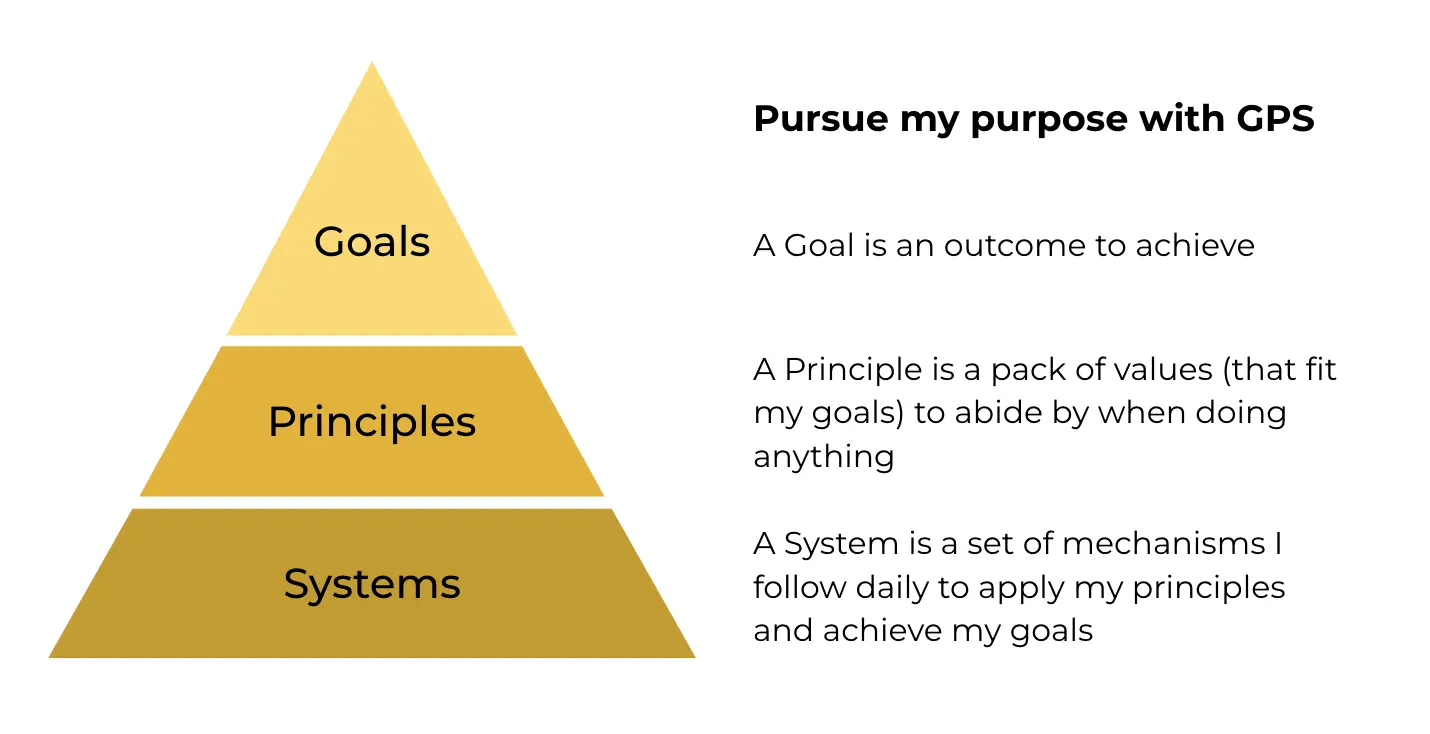
Mission → short, mid, long term goals → measured by specific objectives- Pursue my mission with GPS (Goals, Principles, Systems)
- A
Goalis a outcome I hope to achieve- An objective is a specific and measurable action that can be reached in a short amount of time, often related to a goal
- Goals rarely change, objectives change with time
- Only focus on 3 professional objectives at once
- A
Principleis a pack of values (fit for my goals) I abide by when doing anything- Rarely changes, potentially changes with goals
- A
Systemis a set of mechanisms that I abide by to assist me in applying principles and achieving my goals- Changes with learning, experimenting, and reflecting
Wellbeing and relationships are highly interconnected & correlated
- 1st iteration 01/10 2023 trip to la
- 2nd iteration 12/22/2023
- 3rd iteration 04/25/2025
Goals
| Goals in Personal Life | Objectives (specific and measurable) |
| Attain a balanced wellbeing | Wellbeing is Mental, Physical, and Finance wellbeing |
| Build deeper relationships | Improve my Emotional intelligence |
| Goals in Professional Life → mission | Objectives (specific and measurable) |
| Long: 10+ years | Raise the aggregate happiness score of people by raising the overall level of humans’ - Quality of Relationships (Harvard study)- Emotional intelligence (HBR)- self-awareness, self-regulation: understand and regulate your own emotions - social awareness, social regulation: care and support others - Emotional wellness- helps humans reset hedonic (pleasure) set points |
| Mid: ~5 years | Create and spread technology innovations that - enables users to better savor everyday life experiences and live more intentionally by- enhancing users’ emotional self-awareness- help users understand the root causes of such feelings- aid users in self-regulating such emotions- assists users in deepening their relationships by- improving the quality of human interactions online through more meaningful conversations- making communication channels available for users to better - empathize with one another ( social awareness)- support one another ( social regulation) |
| Short: ~1 year | Acquire the necessary knowledge, experience, and skills needed to become a changemaker |
| Principles (Maxims) | Personal (Self) | Interpersonal (Self & Others) | Context |
Optimize Balance | SPEWStress and comfort Pain and pleasureEquanimity (inner & outer world) Work and rest | Competition: Compete on skillsets, worldview Don’t compete on networks, status, experience | dopamine nation, huberman, cal newport, meditation, 3:1 ugba |
Be Entrepreneurial and Proactive | Be visionary and focus on learning, testing, iterating, doing, improving myself, being proactiveMindset: circle of influence and circle of concern Build antifragility → resilient, growth mindset, experiment | projects and challenge network- meet new ppl, socializing - Get to know ppl more fully - In romantic & platonic relationships, take lead, take risks | YC, startup of you 7 habits, GenZ, |
Be Humble | Curiosity (know that i know nothing) about stuff and ppl; becoming a novice again and again to get what i want, i have to deserve what i want | - Show vulnerability - Taroko Gorge perspective | Dopamine nation, brene brown; Alan Chan, Jeff Wong, Bob Iger, behave |
Practice Abstinence in human urges (that are not fit in this world) | MISS Material possessionsacting on Intuitive thoughtsSocial comparisonSupernormal stimuli Love your future self, doing the harder but good thing, earn ur self respect | No | Huberman, Dopamine Nation, Thinking fast and slow, supernormal stimuli, cavemen syndrome |
Be Present | focus and deep work | stay in the present, pay attention to what has heart and meaning (improv) | |
Be Positive | Be an optimist, smile & be grateful for everything around you; naive view of regret minimization No blame, you only know ur own emotions | exude positivity and energy | Yale, 3:1, Romina NVC, ori |
Say Yes by | - in doing the work - trying new things | HTHelping →make other’s people’s lives better, make your partner look goodTrying | By saying yes, we accept the reality created by our partners and begin the collaborative process from the start of a scene. The collaborative process—or group mind—helps make us giants, animals, villains, saints and more importantly put us in situations that we would normally avoid. This is a wonderful life |
| Systems | Mechanisms |
| Habits | 21 day system to do 4-5 of the 6 habits every two days (Sunday on its own) 1, 2 Wake up at 8 & Morning Routine - 盥洗, coffee, Exercise, Cold Shower, Sunlight 3. Schedule and tracking → notion 4. Meditation 5. Exercise (cardio or weights) 6. Read: Nightly Routine & Sleep at 12 - 盥洗, Gratitude Read |
| Energy & Focus | Energy- Sleep 7.5-8 hours a day from 12-8; wash at 1130 - Morning: Drink coffee, Sunlight, Exercise, WIFI no autojoin- Afternoon: Meditation, Workout - Night: Dim the lights, use less technology Task management- Only focus on 3 main professional objectives at once - Scheduling my days into 90min chunks while putting deep work in the morning - Wind down a day with closed laptop saying “wind down complete” Abstinence- Turn off my phone when I am not using it → black and white - DURING SEMESTER, No Instagram & youtube on phone, no Netflix on computer |
| Aspirations | - Pursue my mission with GPS (Goals, Principles, Systems) - Annual reflections and planning → purpose to impact plan (all goals)- Monthly calibrations (6-months part only) |
| Learning | - Acquire Mental Models from channels like text, audio, video - Read & learn during commutes and at night |